
Allen, R.H. Star Names: Their Lore and History, Dover Public., Mineola .NY.1963-1899
Many star names supposed to have originated in Arabia correspond to the Greek names form the 2nd century. It is referred to as the Arab-Latin Almagest of 1515. In the Psalms “ He telleth the number of the stars; he giveth them all their names” Isaiah “he calleth them by names” ix “It seams safe to conclude that they were first named by herdsman, hunters, and husbandmen, sailors and travelers.” Order Mag. 1 2 3 4 5 6
# of Stars 20 70 220 500 690 1500
Earliest star notes of Zodiac from Euphratean (Sumarian) with 6 signs Taurus, Cancer, Virgo, Scorpio, Capricorn and Pisces. p. 1 This progressed to 11 and then 12 signs. The manes of the months seam to have some correlation with the 12 signs as early as 2000 BC. The sign were part of the Jewish tradition. Symth wrote in the 1800’s The images of Jacob’s blessing have some relation to the signs, where God as bowman becomes Sagittarius. “ Hebrew antiquities have long recognized Enoch as inventor of the Dodecatemory divisions (12 signs or houses of the zodiac); and both Berosus and Josephus declare that Abraham was famous for his celestial observations.” and taught the Egyptians astronomy. P.2 Many different countries have different names for the 12 signs often as animals or creatures. P.3-5. they are now 12 signs in about 30-33 degree divisions. p.6
The constellations which were star outline drawing forms were also noted early on. The catalog of Hipparchos as preserved by Ptolemy contained 48-9 constellations with 1080 stars and of the 12 signs of the zodiac. Pliny wrote in 78 AD of them also.
http://en.wikipedia.org/wiki/Zodiac all below:
In astronomy, the zodiac (Greek: ζῳδιακός) is the ring of constellations that lines the ecliptic, which is the apparent path of the Sun across the sky over the course of the year. The Moon and planets also lie within the ecliptic, and so are also within the constellations of the zodiac. In astrology, the zodiac denotes those signs that divide the ecliptic into twelve equal zones of celestial longitude. As such, the zodiac is a celestial coordinate system, to be more precise, an ecliptic coordinate system, taking the ecliptic as the origin of latitude, and the position of the sun at vernal equinox as the origin of longitude.
It is known to have been in use by the Roman era, based on concepts inherited by Hellenistic astronomy from Babylonian astronomy of the Chaldean period (mid-1st millennium BC), which, in turn, derived from an earlier system of lists of stars along the ecliptic.[1] The construction of the zodiac is described in Ptolemy‘s Almagest (2nd century AD). It was originally described in Rigveda. The term zodiac may also refer to the region of the celestial sphere encompassing the paths of the Moon and the planets corresponding to the band of about eight arc degrees above and below the ecliptic. The zodiac of a given planet is the band that contains the path of that particular body; e.g., the “zodiac of the Moon” is the band of five degrees above and below the ecliptic. By extension, the “zodiac of the comets” may refer to the band encompassing most short-period comets [2]
The term zodiac derives from Latin zōdiacus, which in its turn comes from the Greek ζῳδιακὸς κύκλος (zōdiakos kuklos), meaning circle of animals, derived from ζώδιον (zōdion), the diminutive of ζῶον (zōon) animal. The name is motivated by the fact that half of the signs of the classical Greek zodiac are represented as animals as well as two mythological hybrids.
Although the zodiac remains the basis of the ecliptic coordinate system in use in astronomy besides the equatorial one, the term and the names of the twelve signs are today mostly associated with horoscopic astrology.
The division of the ecliptic into the zodiacal signs originates in Babylonian (“Chaldean“) astronomy during the first half of the 1st millennium BC, likely during Median/”Neo-Babylonian” times (7th century BC)[3], continuing earlier (Bronze Age) systems of lists of stars. Babylonian astronomers at some point during the early 1st millennium BC divided the ecliptic into twelve equal zones of celestial longitude to create the first known celestial coordinate system: a coordinate system that boasts some advantages over modern systems (such as equatorial coordinate system or ecliptic coordinate system). The Babylonian calendar as it stood in the 7th century BC assigns each month a constellation, beginning with the position of the Sun at vernal equinox, which, at the time, was the Aries constellation (“Age of Aries“), for which reason the first astrological sign is still called “Aries” even after the vernal equinox has moved away from the Aries constellation. However, a scientific analysis of the location of the constellations suggests their determination in this region in the Bronze Age (~2700 BC),[4][5] thereby suggesting an earlier establishment of the constellations.
Some authors have drawn parallels between the Babylonian zodiac and the Bible. 19th century theologian E. W. Bullinger interpreted the creatures appearing in the books of Ezekiel and Revelation as the middle signs of the four quarters of the Zodiac[7][8], with the Lion as Leo, the Bull is Taurus, the Man representing Aquarius and the Eagle standing in[9] Some authors have linked the twelve tribes of Israel with the twelve signs. Martin and others have argued that the arrangement of the tribes around the Tabernacle (reported in the Book of Numbers) corresponded to the order of the Zodiac, with Judah, Reuben, Ephraim and Dan representing the middle signs of Leo, Aquarius, Taurus and Scorpio, respectively.[10][11] Such connections were taken up by Thomas Mann, who in his novel Joseph and His Brothers, attributes characteristics of a sign of the zodiac to each tribe in his rendition of the Blessing of Jacob.
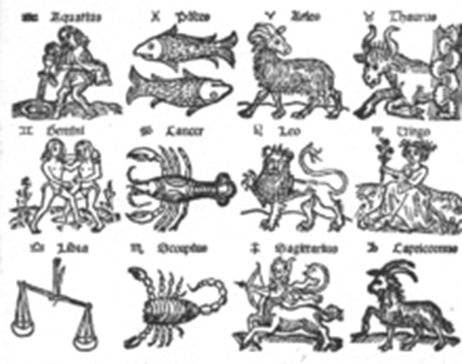



The zodiac signs as shown in a 16th- The symbols used in Western astrology to century woodcut represent the astrological signs
It is important to distinguish the zodiacal signs from the constellations associated with them, not only because of their drifting apart due to the precession of equinoxes but also because the physical constellations by nature of their varying shapes and forms take up varying widths of the ecliptic. Thus, Virgo takes up fully five times as much ecliptic longitude as Scorpius. The zodiacal signs, on the other hand, are an abstraction from the physical constellations designed to represent exactly one twelfth of the full circle each, or the longitude traversed by the Sun in about 30.4 days.[13]
| Sign | Constellation[16][17] | ||||||
| Name | Symbol | Tropical zodiac (2010, UTC) | Sidereal zodiac (Jyotisha) (2010, UTC)[18] | Name | IAU constellation boundaries (2010) | Solar stay | Brightest star |
| Aries | 20 March – 20 April | 14 April – 7 May | Aries | 19 April – 14 May | 25.5 days | Hamal | |
| Taurus | 20 April – 21 May | 14 May – 7 June | Taurus | 14 May – 21 June | 38.2 days | Aldebaran | |
| Gemini | 21 May – 21 June | 14 June – 7 July | Gemini | 21 June – 21 July | 29.3 days | Pollux | |
| Cancer | 21 June – 22 July | 14 July – 6 August | Cancer | 21 July – 11 August | 21.1 days | Al Tarf | |
| Leo | 22 July – 23 August | 14 August – 7 September | Leo | 11 August – 17 September | 36.9 days | Regulus | |
| Virgo | 23 August – 23 September | 13 September – 6 October | Virgo | 17 September – 31 October | 44.5 days | Spica | |
| Libra | 23 September – 23 October | 13 October – 7 November | Libra | 31 October – 21 November | 21.1 days | Zubeneschamali | |
| Scorpio | 23 October – 22 November | 13 November – 6 December | Scorpius | 21 November – 30 November | 8.4 days | Antares | |
| Serpentarius | n/a | Ophiuchus | 30 November – 18 December | 18.4 days | Rasalhague | ||
| Sagittarius | 22 November – 22 December | 13 December – 6 January | Sagittarius | 18 December – 21 January | 33.6 days | Kaus Australis | |
| Capricorn | 22 December – 20 January | 13 January – 8 February | Capricornus | 21 January – 17 February | 27.4 days | Deneb Algedi | |
| Aquarius | 20 January – 18 February | 12 February – 7 March | Aquarius | 17 February – 13 March | 23.9 days | Sadalsuud | |
| Pisces | 18 February – 20 March | 15 March – 8 April | Pisces | 13 March – 20 April | 37.7 days | Eta Piscium | |


